


Shopify Editions Fall ’26 for Theme Developers: New Theme Architecture
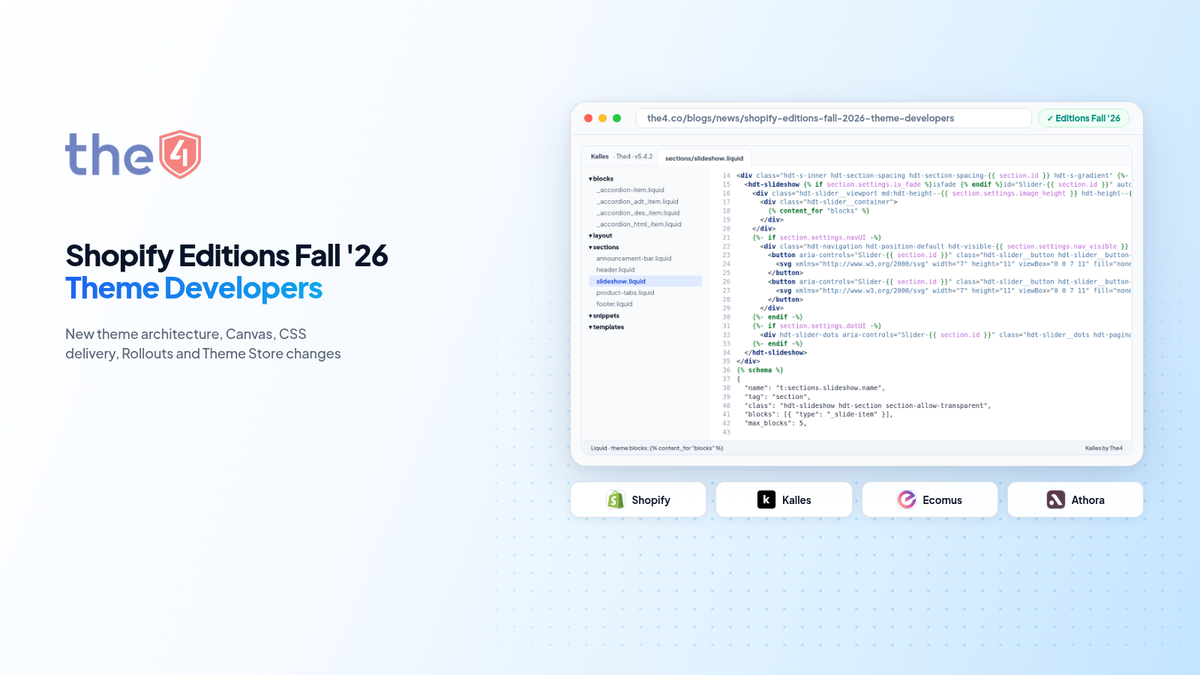
For theme developers, Fall 2026 has one announcement that will shape the next year of work: a new theme architecture that Shopify's new store editor is built on. Around it sit changes to CSS delivery, Hydrogen, the Theme Store, CLI tooling, and app integrations. This guide stays technical. If you need something to send clients, our Fall 2026 guide for store owners covers the merchant side.
The new theme architecture, in Shopify's words
Short answer: Shopify Editions Fall 2026 for theme developers — new theme architecture with Liquid blocks, typed contracts, and partial updates · markdown files that guide Sidekick · built-in Tailwind styling · automatic per-page CSS delivery · Rollouts APIs, Theme Store app add-ons, Hydrogen primitives, and non-interactive CLI commands.
| Area | What changed | Number Shopify gives |
|---|---|---|
| Theme architecture | Liquid with blocks, typed contracts, partial updates | Tailwind built in; markdown files guide agents |
| CSS delivery | Only the CSS each page uses is delivered | Platform-level, no theme change described |
| Canvas | Store editor built on the new architecture | No theme to launch 20% faster |
| Theme Store | Attach an app add-on to a listing | Official theme plus app pairing |
| RTL | Arabic, Hebrew, and Urdu storefronts | 600M+ readers |
| Store search | Improved suggestions | Add-to-carts from search up 8% |
The Editions page describes it in one line: compose pages in Liquid with blocks, typed contracts, and partial updates; guide agents with markdown files; and get Tailwind styling built in. A note underneath adds that the new way to edit online stores is built on this architecture.

Taking each piece at face value:
- Liquid with blocks. Pages are still composed in Liquid, with blocks as the building unit.
- Typed contracts. Shopify names typed contracts as part of the architecture. The detail lives in the dev docs, and it's the part we'd read first.
- Partial updates. Listed as a core capability alongside blocks.
- Tailwind built in. Styling with Tailwind is part of the architecture rather than something you bolt on.
- Markdown files for agents. Markdown files guide agents. Elsewhere on the page, Shopify says these files teach Sidekick how your theme is built and store design preferences across conversations.
We're deliberately not guessing at syntax or migration paths here; the Editions page doesn't give them. Read the linked dev docs before you change a production theme.
We're reading the docs line by line. It's the biggest change for us in years. Don't skip it.
What Canvas means for your themes
Canvas lets merchants design the whole store in one view and work with Sidekick, which can stage multiple changes at once and write code. Shopify says it gets stores from no theme to launch 20% faster. Merchants can also design with Canvas from agents such as ChatGPT and Claude.
For developers, the implication is simple. Your customers will increasingly edit through an AI-assisted editor sitting on the new architecture. How well your theme describes itself (theme structure, code conventions, and design preferences in markdown) affects the quality of the edits they get. Treat those markdown files as part of the product, not documentation you add later.
CSS: only what the page uses
Per-page CSS delivery: Online store pages load faster because Shopify serves only the CSS each page uses · platform-level change with dedicated developer docs · re-check your stylesheet organization and benchmark page speed after rollout.
We'll re-benchmark our own themes. It's the only way to know.
Rollouts and theme releases
Merchants can now schedule rollouts that include the theme together with checkout configuration, market catalogs, and discounts, and A/B test elements of the store across headless builds, POS, Google Shopping, and the Shop app. On the API side, you can query the Admin API to see which resources are part of an active rollout and subscribe to webhooks for changes.
If you do custom work for agencies or Plus brands, expect clients to want redesigns delivered as rollouts, and plan your handoff process around that.
We think this changes handoffs. That's good news.
Theme Store: app add-ons
You can now attach an app add-on to your listing on the Shopify Theme Store to offer businesses richer functionality. For teams that maintain a theme and a companion app, this gives you an official way to pair them on the listing.
Related: apps can no longer create or update script tags and must migrate to theme app extensions or web pixels. If your theme documentation recommends apps or shows integration snippets that rely on script tags, update it, and make sure your theme exposes the app blocks and areas that extension-based apps need.
Headless: Hydrogen and Vercel
Hydrogen gets production-ready primitives including customer accounts, predictive search, built-in agent skills, and one-click deploys to Vercel. Vercel Shop is Vercel's production-ready Next.js template, built on the new Hydrogen SDK. The mock.shop agentic reference library lets any agent build a store and then publish to Shopify.

We haven't tested Vercel Shop yet. It's on our list.
Tooling for theme work
- Shopify CLI is optimized for non-interactive input and output, letting you manage apps, store themes, and stores from your preferred agent.
- Agents can create, list, or delete dev stores entirely from the CLI.
- You can start building a store with Shopify CLI before signing up and keep what you create.
- The redesigned Dev Dashboard has a store index page combining every store type, where you can request collaborator access.
- Partner profiles & referrals: Org details in the Dev Dashboard show on collaborator requests · partner referrals pay subscription revenue and online GMV across all plans for 4 years.
Smaller items that touch themes
- Stores can launch in right-to-left languages: Arabic, Hebrew, and Urdu. Test your theme mirrored.
- WebMCP tools let agents discover products, create carts, and guide checkout using structured tools registered by online stores.
- Shop sign-in can be added to any store, including stores not on Shopify, and to lead capture forms.
- Store search suggestions improved, with add-to-carts from search up 8%.
- Merchants can edit metafields in context and group analytics by category metafields and metaobjects. Metafield-driven sections stay important.
A few more platform notes for agencies
Agency platform notes: Shopify Functions read delivery-option metafields today, with per-checkout metaobject reads coming soon · updated Checkout Kit embeds checkout into web storefronts, mobile apps, and agent experiences · Polaris adds 14 CDN component APIs with semantic versioning · apps can push events and GraphQL annotations to Shopify Analytics · all listed apps must migrate to expiring tokens before January 2027.

Plan for the next release cycle
- Read the new theme architecture docs end to end.
- Write markdown files describing your theme's structure and design rules.
- Benchmark pages after the CSS delivery change.
- Run an RTL pass on every template.
- Remove script-tag-era integration advice from your docs.
- Decide whether an app add-on belongs on your Theme Store listing.
- Try driving dev stores and theme tasks from Shopify CLI with an agent.
When a free theme or the native editor is enough
When native tools fit: A free Shopify theme plus Canvas covers standard catalog sections · Translate & Adapt handles storefront translations for free · we'd quote custom Liquid builds only where native tools hit a limit you can show the client.
Theme developer FAQ
Is Tailwind required in the new architecture?
The page says Tailwind styling is built in. It doesn't say it's mandatory. Check the dev docs.
Do existing themes keep working?
The Editions page doesn't address this directly. It says the new editing experience is built on the new architecture; confirm compatibility details in the docs.
What are the markdown files for?
They guide agents. Shopify says they teach Sidekick how a theme is built and save design preferences across conversations.
Can I bundle an app with my theme listing?
You can attach an app add-on to your Shopify Theme Store listing.
Source: Shopify Editions Fall 2026. Merchant version: what Fall 2026 changes for theme-based stores.